
Manufacturing
How radios move on the ground
On a production floor, radios are how line leads reach maintenance, how a supervisor pulls someone off the line, and how a safety issue gets flagged before it becomes a shutdown. Communication has to work over machine noise, through PPE, and across a floor that may be organized into cells or departments that rarely see each other. Radios in this environment get handled constantly — clipped on, unclipped for machine work, set on a workbench, handed to a relief operator mid-shift. Every one of those handoffs is a point where a radio can end up somewhere other than where the next person expects it.
Where radios go missing
- Set on a workbench or machine console during a task and left behind at shift change
- Left in a locker or PPE cage when an operator changes stations
- Handed off informally between line leads without any log of who has what
- Left in a break room or cafeteria during a rotation and picked up by the wrong shift
What a designated Radio Area solves
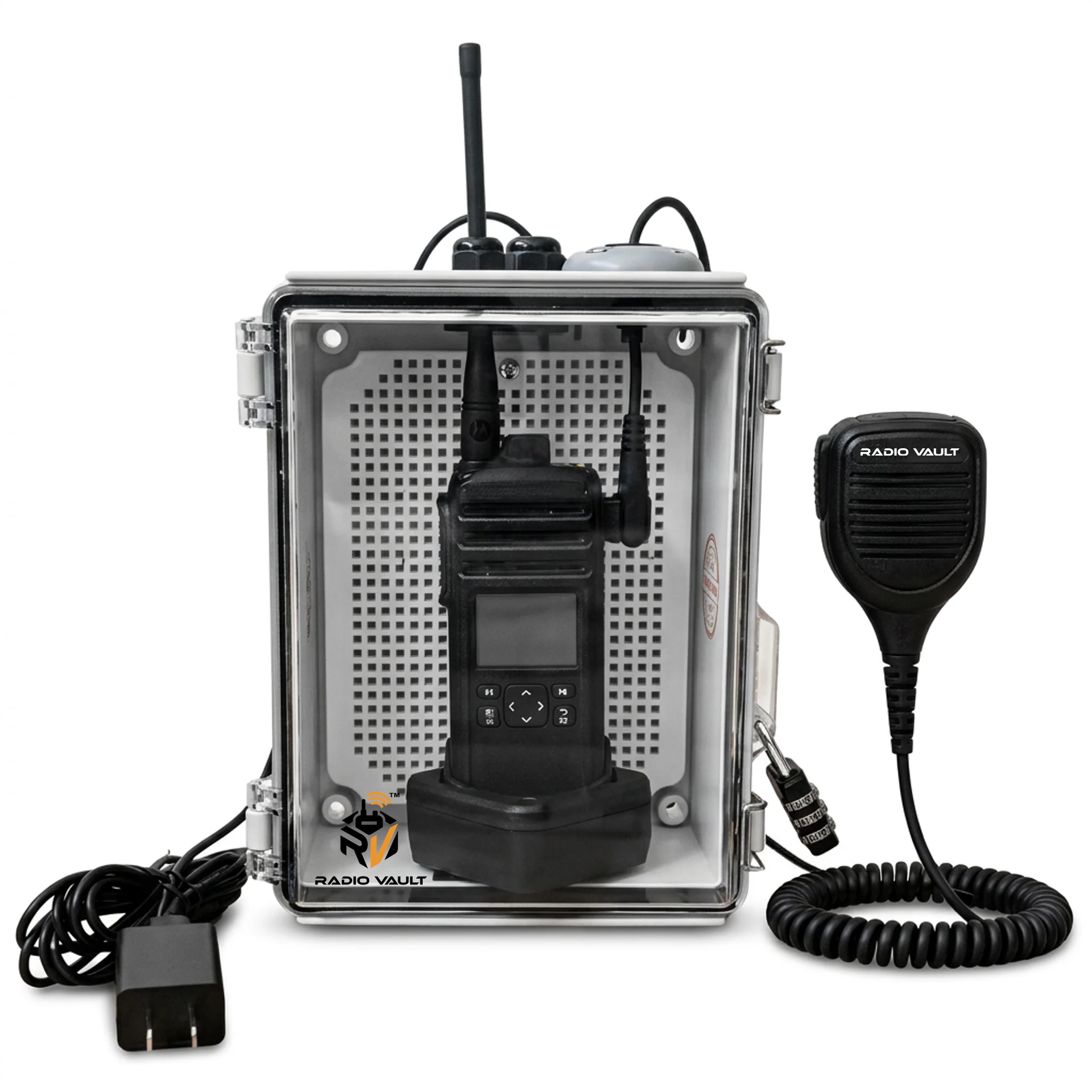
A fixed Radio Area near each production zone or at a central shift-change point turns radio handling from an informal habit into a physical routine: check in, check out, at a defined spot. A locked enclosure keeps each radio charged and ready between shifts, and the external speaker microphone means operators can talk without unlocking or removing the unit — useful when hands are full, gloved, or busy mid-task.
Deployment guidance for this environment
- Place a station at each production line or cell if the floor is large enough that a single point isn't reachable
- Position away from direct exposure to spray, coolant, or dust where the line process allows
- Locate near existing shift-change gathering points — a supervisor's station, a time clock, or a line entrance
- Route power from the same circuits already serving line equipment or task lighting nearby
Questions worth answering before you deploy
- Does the plant have one shift-change point or several that each need their own station?
- Is the mounting location protected from the specific hazards of that process (heat, spray, dust)?
- Are radios assigned to a role or line position, or truly shared — and does the station design match that?
- Who is responsible for confirming radios are returned before a shift leaves the floor?
Confirm your radio model first.
Because each unit is built around one radio model, we recommend confirming your exact make and model number with us before you order. Send us the model and we will confirm the speaker microphone and charging cable configuration for it — that way the unit works the moment it is mounted.
Go deeper
RadioVault Radio Enclosure
A lockable, clear-front enclosure that secures a shared radio in place and keeps it charging between users.
Read more →Two-Way Radio Accountability Best Practices
Assignment logs, numbering, shift handoff checks, and the small operational rules that stop radio loss from becoming routine.
Read more →Other environments with the same problem
Warehouses & Distribution Centers
Shift handoffs, wide floors, and shared handhelds that never come back to the same place twice.
Read more →Security Operations
Post-to-post radio handoffs where a dead battery is a coverage gap.
Read more →Construction Sites
Temporary sites, rotating trades, and equipment that walks off the job.
Read more →Ready to secure your radios?
Buy a configured RadioVault on Amazon, or tell us about your facility and we will scope the deployment with you.
Not sure your radio is a match? Confirm your radio model before you order.