
Warehouses & Distribution Centers
How radios move on the ground
A distribution center runs on a small fleet of shared radios moving between pickers, forklift operators, dock leads, and supervisors across multiple shifts. Nobody owns a specific unit — whoever is on the floor grabs whatever radio is closest at the start of a shift. That works fine for communication, but it is a poor system for accountability. When a radio is everyone's responsibility, it is effectively no one's responsibility, and that is exactly the condition under which radios get set down on a pallet, left in a break room, or driven off on a forklift and never missed until the next shift needs it.
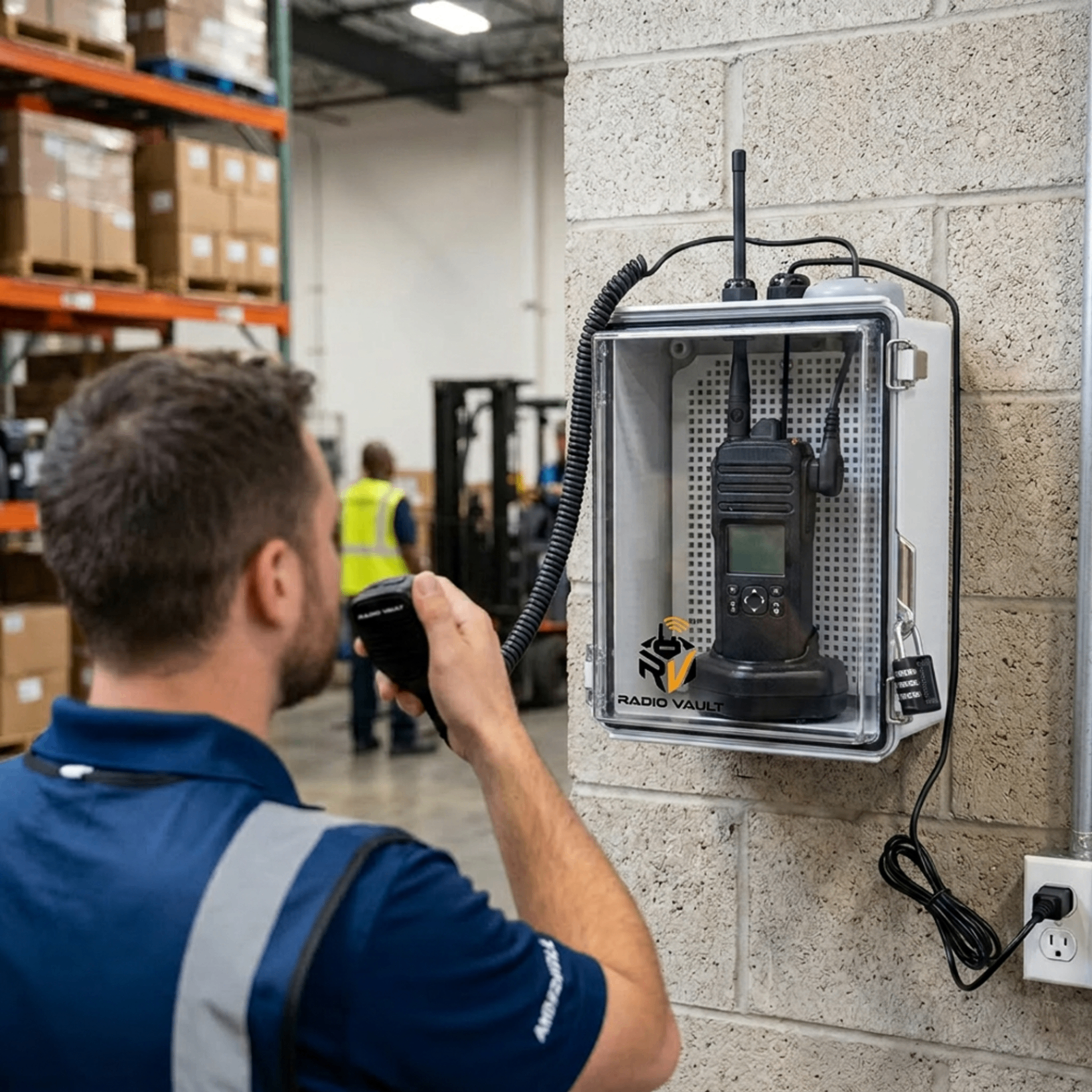
Where radios go missing
- Left on pallet racking or a staging table after a pick run and buried under inbound freight
- Set down in the forklift cab or on a dock leveler and forgotten at shift change
- Carried into the break room or restroom and left behind during a rush
- Walked out the shipping door in a jacket pocket at the end of a shift
What a designated Radio Area solves
A designated Radio Area gives the facility one visible, marked, powered location where every shared radio starts and ends its shift — instead of a general expectation that radios get returned 'somewhere.' A locked RadioVault enclosure at that spot keeps the radio charging and secured between users, while the reflective Radio Area board makes the station findable from across a large floor, including in dim aisles or from a lift truck at distance.
Deployment guidance for this environment
- Mount near the time clock, shift-change muster point, or dock office where every shift already passes through
- Keep it out of high-forklift-traffic lanes but within sight of a main aisle for visibility
- Position near an existing outlet — main power runs in most DC break areas and dock offices make this easy
- For multi-dock facilities, place one station per dock zone rather than a single central point crews won't walk back to
Questions worth answering before you deploy
- How many radios does each shift actually need, and does the station support that count?
- Is the location visible from the main receiving and shipping aisles, not just from the office?
- Does the return habit get built into the shift-change checklist, not left as an assumption?
- Will forklift and pallet-jack traffic patterns keep the area clear, or does it need protective placement?
Confirm your radio model first.
Because each unit is built around one radio model, we recommend confirming your exact make and model number with us before you order. Send us the model and we will confirm the speaker microphone and charging cable configuration for it — that way the unit works the moment it is mounted.
Go deeper
RadioVault Radio Enclosure
A lockable, clear-front enclosure that secures a shared radio in place and keeps it charging between users.
Read more →How to Create a Radio Area in a Warehouse
Choosing the location, marking it clearly, powering it, and building the habits that make a warehouse Radio Area stick.
Read more →Other environments with the same problem
Manufacturing
Line-side communication that has to survive noise, shift rotation, and constant handling.
Read more →Security Operations
Post-to-post radio handoffs where a dead battery is a coverage gap.
Read more →Construction Sites
Temporary sites, rotating trades, and equipment that walks off the job.
Read more →Ready to secure your radios?
Buy a configured RadioVault on Amazon, or tell us about your facility and we will scope the deployment with you.
Not sure your radio is a match? Confirm your radio model before you order.