
Security Operations
How radios move on the ground
Security operations depend on a radio being reachable at every post, every shift, without exception. Post-to-post handoffs happen constantly — a guard finishing a shift passes a radio to the incoming officer, or a roving patrol swaps units at a muster point. Unlike a warehouse or plant, the stakes of a missing radio here are less about replacement cost and more about a coverage gap during exactly the window when it matters. A dead battery discovered at the start of a shift, or a radio left in the previous officer's vehicle, means a post is unreachable until someone notices.
Where radios go missing
- Left in a patrol vehicle or with the outgoing officer instead of returned to the post or base
- Set down at a guard shack or reception desk and not picked back up before a roving assignment
- Left charging on a personal desk charger instead of the shared or accountable station
- Taken off-site inadvertently at the end of a contract shift
What a designated Radio Area solves
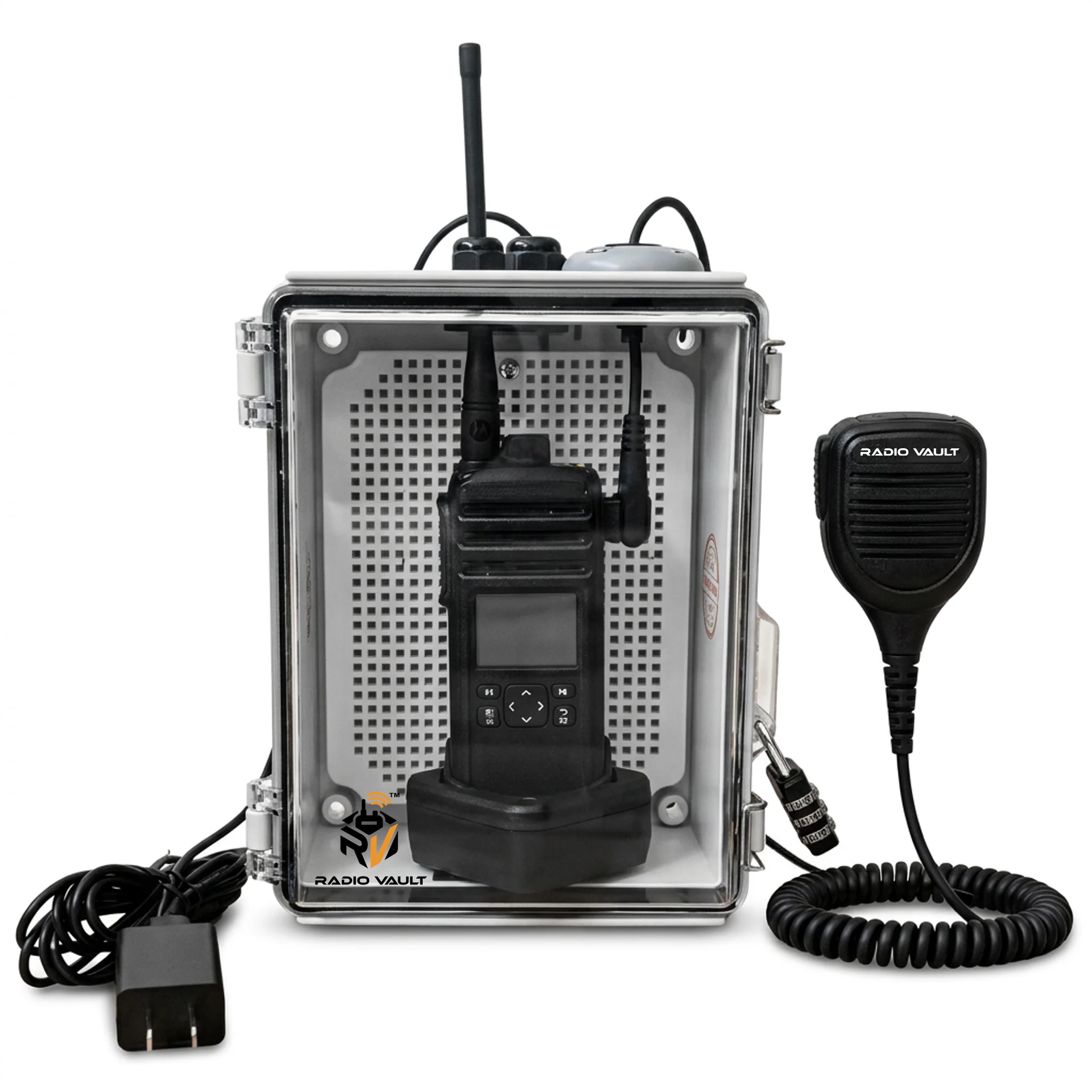
A designated Radio Area at the guard station, base of operations, or muster point makes the handoff itself the trigger for returning a radio to its charging point rather than the next task on someone's mind. Because the RadioVault enclosure locks and stays charging, an incoming officer can rely on a known-good radio at shift start without checking battery status or hunting for a spare, and supervisors have one visible spot to audit rather than several possible locations.
Deployment guidance for this environment
- Mount at the primary guard station, dispatch desk, or base of operations where shift check-in already happens
- For multi-post sites, add a secondary station at a satellite post or muster point serving remote coverage areas
- Keep the unit within the supervisor's sightline where possible, supporting a quick visual accountability check
- Confirm continuous power at the mounting point — security posts are frequently staffed around the clock
Questions worth answering before you deploy
- Does every post have a clear return point, or does the radio pool only have one central location for a distributed team?
- Is the check-in/check-out step built into the shift briefing, not left to individual habit?
- How many radios need to be charged and ready at once for peak shift overlap?
- Does the station location support a quick supervisor audit at shift change?
Confirm your radio model first.
Because each unit is built around one radio model, we recommend confirming your exact make and model number with us before you order. Send us the model and we will confirm the speaker microphone and charging cable configuration for it — that way the unit works the moment it is mounted.
Go deeper
RadioVault Radio Enclosure
A lockable, clear-front enclosure that secures a shared radio in place and keeps it charging between users.
Read more →How to Prevent Two-Way Radios From Getting Lost
A practical process for keeping shared handhelds accounted for: fixed home locations, shift checks, ownership, and physical controls that actually hold up.
Read more →Other environments with the same problem
Warehouses & Distribution Centers
Shift handoffs, wide floors, and shared handhelds that never come back to the same place twice.
Read more →Manufacturing
Line-side communication that has to survive noise, shift rotation, and constant handling.
Read more →Construction Sites
Temporary sites, rotating trades, and equipment that walks off the job.
Read more →Ready to secure your radios?
Buy a configured RadioVault on Amazon, or tell us about your facility and we will scope the deployment with you.
Not sure your radio is a match? Confirm your radio model before you order.